If you find that your favorite fountain pen won’t write any more or the nib is starting to skip and have trouble writing, it is quite possible your nib and inkfeed are clogging with old dried ink.
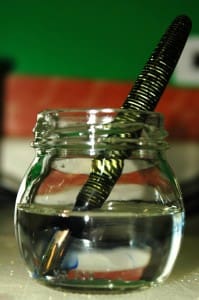
Soaking a fountain pen is often one of the fastest ways to help it write better. Just stick the nib in a cup of water, but not too deep–just enough to soak the nib and the inkfeed beneath it. This leaches out the old dried ink and helps to loosen the remaining ink inside the pen. Once the nib is clean, it likely will write as good as new.
Infrequent use where you let your ink dry out inside the pen can often lead to clogged nibs and inkfeeds. Sometimes heavy use also leads to the same problem. If you fill and write your pen dry twice a week for years on end, the ink still builds up over time.
As a repairman, I find this is actually one of the most common problems pen users face. Whenever possible, I try to save my customers money with this simple advice.
Try to never let your pen dry out. If you know you won’t be using it for a while, empty it back into the inkwell or out in the sink. Of course, even constant use or careful emptying can lead to ink build up, eventually.
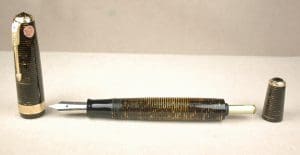
Always remember that room temperature tap water is your friend. (Hot and cold water can ruin your pen.) I find many repairs are easily avoided with a little H2O. Simply soak your pen overnight in a small cup or baby food jar, as in the photo. Don’t immerse the entire pen. Just soak the nib up to the section. The section is the part by which you most likely grip the pen. It is the black grip on this Parker Vacumatic. You can already see the old ink leaching off the nib.
After you let the pen soak for a few hours, the old ink remaining in the pen is softened. Empty out the container and fill it with more room temperature water. Then fill the pen with water several times, until the water is a uniform ink color. Empty and repeat until the pen starts running clear.
Empty the pen of water, and then shake out the remaining water over the sink. Be careful, that slightly tinted water sprays all over. Try your best to keep it in the sink. Wipe down the nib and inkfeed underneath with a paper towel. This helps drain out the last of the ink. I usually let the pen air dry for the remainder of the day. This way, when I refill the pen, the ink doesn’t seem watered down.